REVIEW · KATHMANDU
Mohare Danda Trek
Book on Viator →Operated by Asian Heritage Treks and Travels · Bookable on Viator
Mohare Danda delivers big Himalayan views on quieter trails. This 12-day trek pairs eco-community lodge stays in the Annapurna foothills with classic sunrise viewpoints like Poon Hill, plus cultural days in Kathmandu Valley. You get the peaceful walking, but you’re not stuck in a backcountry bubble.
Two things I like a lot: the way the route gets you close to major massifs from Mohare Hill (around 3,300m), and the practical support structure (a licensed guide, a porter setup, and full-board lodge nights on the trek). The trek is also designed around community projects, so your time on trail has a real-world purpose.
One drawback to plan for: this is a moderate-fitness trek with long walking days, and some itinerary days are heavy on ascent/descent even when the scenery is gorgeous. If you’re prone to getting hit by steep steps or long days, you’ll want to train a bit before you go.
In This Review
- Key points to know before you go
- Why Mohare Danda feels like an efficient Annapurna foothills trip
- Price and value: what you really get for $1,375.33
- Your route in plain English: from Kathmandu icons to Annapurna trails
- Day 1 in Kathmandu: airport welcome, orientation drive, and Thamel time
- Day 2: Swayambhunath, Boudhanath, and Pashupatinath plus a Thamel reset
- Day 3: Kathmandu to Pokhara and the calm before the hiking starts
- Day 4: Galeshwor to Bans Kharka via the Kali Gandaki suspension bridge
- Day 5: Bans Kharka to Naangi through villages, views, and an organic farm school
- Day 6: Mohare Danda arrival, oak and rhododendron forests, and a big sunset look
- Day 7: Ghorepani on the ups and downs, plus sunrise-style mountain views
- Day 8: Poon Hill early start, then Ghandruk village trekking
- Day 9: Down to Nayapul, stone-paved sections, and the drive back to Pokhara
- Day 10 and Day 11: Kathmandu Valley temples, Bhaktapur, and Patan plus a pottery workshop
- Logistics that make this trek easier: guides, porters, permits, and group size
- What to expect on the trail: moderate effort, real time on your feet
- Packing and pacing tips that match this exact itinerary
- Who should book Mohare Danda, and who should pause
- Should you book this Mohare Danda Trek?
- FAQ
- Is pick-up offered for this Mohare Danda Trek?
- What’s included in the trek price?
- What’s not included?
- How many days is the Mohare Danda Trek?
- What fitness level do I need?
- How big is the group?
Key points to know before you go
- Eco-community lodge model: you sleep and eat inside a community-run trekking ecosystem.
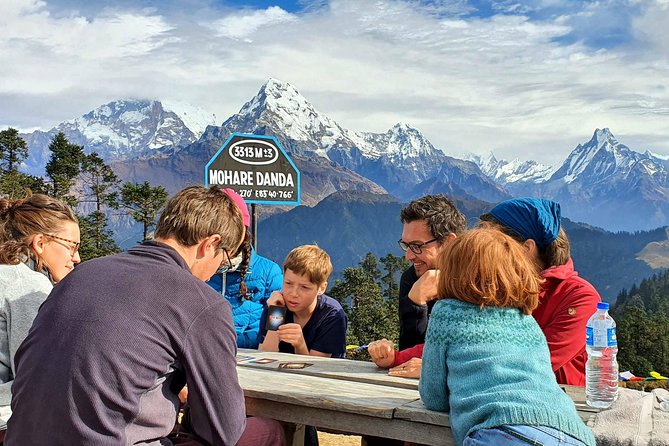
- Mohare Hill at ~3,300m: one of the best “from-here-you-see-everything” moments in the region.
- Kali Gandaki suspension bridge crossing: a memorable add-on early in the trek.
- Two sunrise-style days: Mohare Danda sunset, then Poon Hill sunrise.
- Small group size: max 12 travelers, so days feel more flexible.
- Porter support included: service provided as 2 trekkers: 1 porter.
Why Mohare Danda feels like an efficient Annapurna foothills trip
Mohare Danda Trek is built for travelers who want a short cut to the Annapurna region’s best ingredients: mountain views, village life, forests of oak and rhododendron, and that slow “Nepal rhythm” you can’t really rush. You start with sightseeing days in Kathmandu Valley, then shift into the foothills where the trail feels less like a highway and more like a conversation between hills, farms, and rivers.
The eco-community lodge angle matters because it changes how the trek feels. Instead of treating lodges as a faceless service, you’re supporting a system tied to local livelihoods and community projects. That doesn’t mean every day will feel dramatic or political, but it does mean you can feel the difference in how you’re received and how your meals and rest are handled.
You’ll also like the view math. The itinerary is designed around viewpoints that give you depth: Mohare Danda and nearby viewpoints cover the Annapurna and Dhaulagiri area from a higher vantage than the more famous “lower” viewpoints alone.
You can also read our reviews of more tours and experiences in Kathmandu.



Price and value: what you really get for $1,375.33
At $1,375.33 per person, this trek isn’t a cheap stroll. But the value comes from the mix of included services that normally cost extra when you book piecemeal.
Here’s what’s included that most people end up paying for separately:
- Private land transportation for the transfers between cities and to trail start/end points.
- An English-speaking local guide and porter service (2 trekkers to 1 porter).
- Permits listed as ACAP, TIMS, and other necessary permissions.
- Lodging: 4 nights in Kathmandu (4* Yatri Suites & Spa or similar), 2 nights in Pokhara, and 5 nights in eco-community lodges on full board during the trek.
- Meals during the trek period (the program specifies breakfast/lunch/dinner counts).
What’s not included is also important, because it affects your real total:
- Entrance fees for heritage sites (approx. USD 50 per person).
- Tipping for guide/driver/supporters.
- Your insurance and any international flights.
- Drinks during Kathmandu/Pokhara days.
So the question isn’t just “is it expensive.” It’s “does it reduce stress enough that you’re happy paying for structure.” If you want a guided, permission-sorted, lodge-supported trek without having to micromanage logistics, the price can make sense.
Your route in plain English: from Kathmandu icons to Annapurna trails
Your trip is a loop that goes:
Kathmandu sightseeing → drive to Pokhara → trail into the Annapurna foothills via Kali Gandaki → Mohare Danda area and the community lodge route → Poon Hill area and village trekking → down toward Nayapul → back to Pokhara and then Kathmandu for more heritage stops.
This design helps you in two ways:
1) You ease into hiking. The trek days are spaced with clear transitions, so you’re not thrown from sightseeing straight into a punishing mountaineering-style grind.
2) You get multiple “Nepal moods.” Days 1–3 are temple-and-city orientation. Then you’re back on your feet daily. Then you finish with heritage sites again, which feels like a good landing for the trip.
Day 1 in Kathmandu: airport welcome, orientation drive, and Thamel time
After arriving at Tribhuvan International Airport, you get an airport welcome by the tour representative with a nameplate. Then you’re transferred to a hotel in downtown Kathmandu, near the main tourist area.
On the way, you pass some Kathmandu highlights: Pashupatinath Temple, the Royal Palace Museum (Narayanhity), Garden of Dreams, and then you end up in Thamel. That matters because Thamel is where you’ll find your first easy access to snacks, trekking odds and ends, and general “I need something small right now” help.
The only real “watch this” detail: you can do a lot of sightseeing from the car window on day one. So don’t over-schedule yourself at night. Keep energy for day two.
Day 2: Swayambhunath, Boudhanath, and Pashupatinath plus a Thamel reset
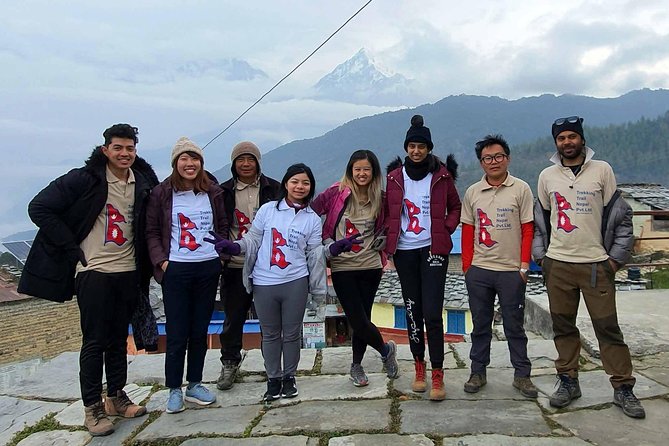
Day two is a strong cultural sampler. You start at Swayambhunath (the Monkey Temple). It’s one of those places where religious practice and city views overlap, giving you both atmosphere and a wide-angle look over Kathmandu and the Himalayan horizon on clear days.
Next stop: Boudhanath Stupa, described as dating back to around 600 A.D. You’ll have time to walk around the stupa area and take in the Buddhist pilgrimage vibe and architecture.
Then comes Pashupatinath Temple, one of the most important Hindu pilgrimage sites in the region. The program specifically notes you may witness ritual cremation ceremonies on the Bagmati River banks, which can be a powerful and emotional experience. You also visit Guhyeshwori Temple nearby.
Finally, you return to Thamel for shopping and a casual evening. This is smart. You’re not just touring temples; you also get time to pick up practical items and get your bearings.




Day 3: Kathmandu to Pokhara and the calm before the hiking starts
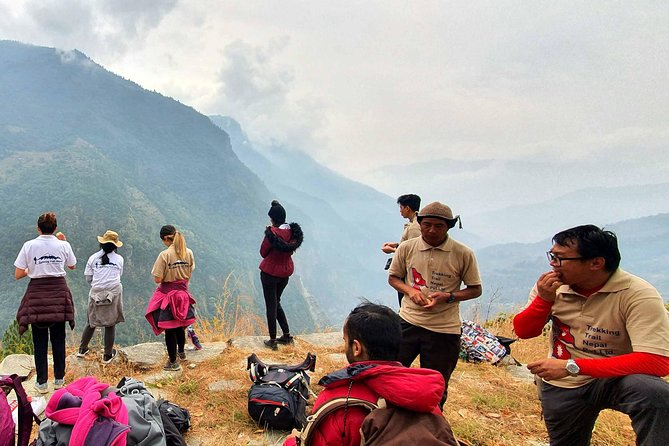
You drive to Pokhara (about 3 hours). This day is mostly about the change of setting. Kathmandu’s altitude and city noise give way to valley greenery and wider mountain views in the distance.
Pokhara is known for scenic viewpoints and lakes, and the program includes time to appreciate the beauty of the valley and clear Himalayan silhouettes in the right weather. Even though this isn’t a hiking day, it’s a key “mental transition day.” You’ll feel the trip turning toward the trail from here.
Day 4: Galeshwor to Bans Kharka via the Kali Gandaki suspension bridge
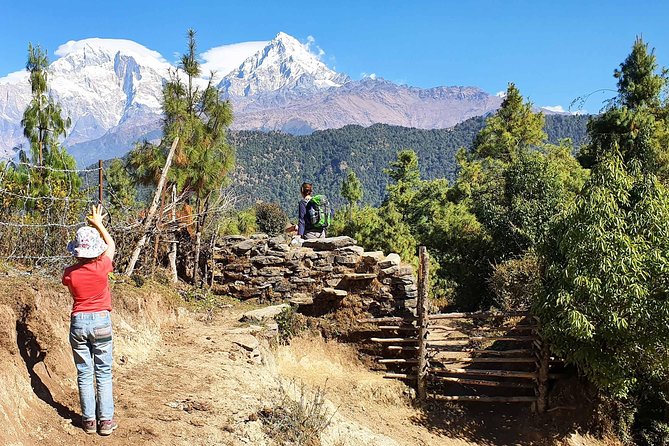
This is where the trek truly starts.
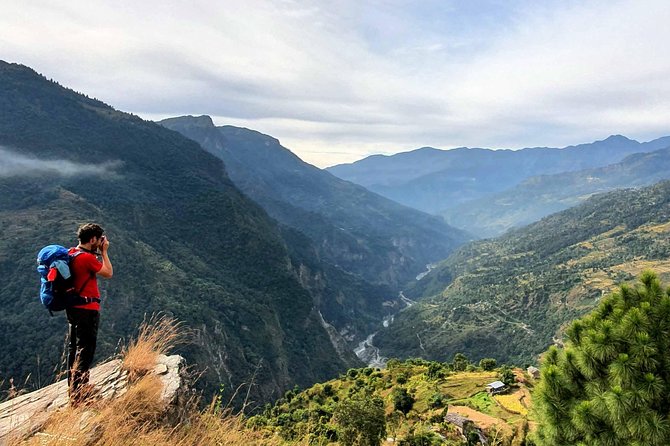
You transfer to Galeshwor along the Kali Gandaki River. Then you begin walking toward Bans Kharka for about 3 hours. The route includes a suspension bridge crossing over the Kali Gandaki, described as the deepest gorge. Even if you don’t care about the depth statistic, you’ll feel the bridge and the river system as a landmark on the day.
After the bridge crossing, you move through green forests. The program also mentions lush forest sections and some decent hiking before reaching Bans Kharka. For me, days like this are where you learn your personal walking rhythm: how fast you go before your legs warm up, and how quickly you need breaks when the path changes from bridge views back into forest shade.
Day 5: Bans Kharka to Naangi through villages, views, and an organic farm school
Today you walk about 6–7 hours from Bans Kharka to Naangi. The day is described as passing villages, mountain views, and impressive scenery.
Two special elements are explicitly included:
- You visit an organic farm school
- You visit a Magar settlement
This is part of why Mohare Danda works well for people who want more than scenery. It gives you cultural context that isn’t limited to temple stops. Farming, education, and local community structure become part of the trek story.
Practical consideration: because this is a long walking day, plan your pace early. If you start too fast, you’ll pay for it later when tiredness makes steep steps feel longer.
Day 6: Mohare Danda arrival, oak and rhododendron forests, and a big sunset look
You continue trekking and reach Mohare Danda. The trail is described as passing through forests of oak and rhododendrons with mountain views including Mt. Fishtail, south Annapurna, Dhaulagiri, and Tukche.
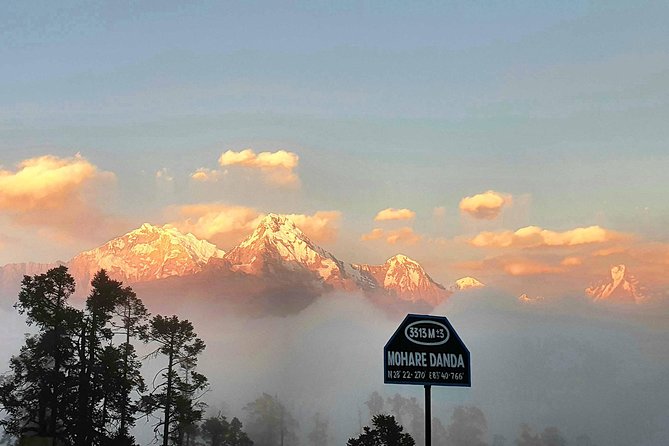
The evening is a highlight: you’re set up to observe a glorious sunset view from Mohare Danda station, then return to the eco-community management lodge.
This is one of the best “reward timing” parts of the trip. You’re not hiking all the time until you’re completely drained. The program builds in a payoff at the end of the day with sunset views from a specific station point.
Day 7: Ghorepani on the ups and downs, plus sunrise-style mountain views
On day seven, the program asks you to wake early for sunrise and crystal-clear views of a list of mountains: Mount Fishtail, Dhaulagiri I and II, Tukche, South Annapurna, Nilgiri, and others. Then you trek toward Deurali with gradual ups and downs until you reach Ghorepani.
It’s about a 5-hour walk mentioned from Mohare Danda to Ghorepani. You check in at the lodge and rest.
This is another part I’d advise you to respect. Sunrise mornings are worth it, but they also mess with sleep schedules. Try to conserve energy the day before and don’t stay out too late after dinner.
Day 8: Poon Hill early start, then Ghandruk village trekking
Day eight begins with the classic move: an early trek to Poon Hill (3210m) to catch the first sunlight. The program says it gives panoramic views of mountains including Annapurna and Dhaulagiri. You also get culturally rich villages along the way.
Then you return to Ghorepani for breakfast and continue onward to Ghandruk. The route is described as crossing flatlands, forests, cultivated lands, and a suspension bridge over Khumbu Khola. You arrive at Ghandruk, a well-known style of village trekking stop in the region.
The big value of this day is variety. One half is sunrise spectacle. The other half is walking through village and agricultural patterns, where you see how people actually live along the trekking corridor.
Day 9: Down to Nayapul, stone-paved sections, and the drive back to Pokhara
After breakfast, you descend to Nayapul (about 5 hours). The program notes walking on a stone-paved trail through villages and terrace framing. You cross Modi Khola, reach Birethanti, then walk to Nayapul. A private vehicle is waiting from there to pick you up and drive back to Pokhara.
This is a “legs and logistics” day. Descent can feel easier than ascent, but it can also be rough on knees and thighs. Take it slow on stepdowns. Once you’re in Pokhara, you’ll have the mental reset that finishing the trekking day deserves.
Day 10 and Day 11: Kathmandu Valley temples, Bhaktapur, and Patan plus a pottery workshop
You drive from Pokhara back to Kathmandu (about 6 hours) and later stroll in Thamel for shopping and souvenirs.
Day 11 adds more heritage:
- Bhaktapur Durbar Square with time to enjoy a meal of your choice
- Pottery Square, with an arranged workshop where a local craftsman teaches you how to make a clay pot
- Patan Durbar Square, plus nearby UNESCO sites like Krishna Temple and Patan Durbar Square, then the Patan Museum
- Visits to the Golden Temple and Banglamukhi Temple
- Drop-off at your hotel
This combination is a nice balance. You get big monuments, but you also get a hands-on craft day. If you like remembering trips through something you made or touched, the pottery workshop is a smart included stop.
Logistics that make this trek easier: guides, porters, permits, and group size
This trek caps at 12 travelers, which helps day-to-day pacing and reduces the “everyone wait around forever” problem. It’s also included with a professional English-speaking local guide and a 2 trekkers: 1 porter ratio, which is the part that actually changes your comfort.
A common mistake is assuming that because the trek is “not super technical,” you don’t need help. On lodge treks, your pack still adds fatigue. With porter service included, you can keep your load manageable for the daily walking.
Permits are also listed as included (ACAP, TIMS, and other necessary permits). That matters because it prevents the annoying scenario of spending time sorting documents when you’d rather be hiking.
And a real-life detail: one past trek experience praised guide Norris and porter Melan for caring for the group and sharing lots of local knowledge. That’s exactly what you want from a guide on a route like this: not just directions, but context while you’re walking.
What to expect on the trail: moderate effort, real time on your feet
The program calls for moderate physical fitness. In practice, that means you should be comfortable with:
- Multi-hour walking days (including a 6–7 hour day and several long transfer-to-trek blocks)
- Steps and uneven ground on descent and ascent
- Early mornings when sunrise viewpoints are scheduled
The trekking days also don’t feel random. Each day has a clear destination lodge or village stop, and the itinerary gives you enough transition points to reset.
One more note: meals are included during the trek portion (breakfast/lunch/dinner counts provided). That helps you control the budget during the hiking days, since you won’t be paying for every meal at a moment when you’re tired and hungry.
Packing and pacing tips that match this exact itinerary
Since you’ll be trekking for multiple days with eco-community lodge stays, pack with comfort and practicality in mind. You might find your biggest needs are:
- Layers for early mornings and cooler elevations
- Supportive footwear for stone paths and steep stepdowns
- A simple rain plan for forest sections
Also, set your pacing strategy before the long day. If you start too fast on day five (the 6–7 hour walk), you’ll likely feel it later. If you start steady, the longer days become more manageable.
If you’re unsure about what gear to bring, you’ll want to confirm what’s provided versus what you must bring. The program lists personal hiking gear and personal kits as not included, so you’ll still need your own trekking basics.
Who should book Mohare Danda, and who should pause
This trek is a great fit if you:
- Want Annapurna foothills walking without spending your entire trip on the most crowded routes
- Like combining mountain views with villages and community stops (organic farm school and Magar settlement days help a lot)
- Prefer a structured program with a guide, porter support, and lodge meals included on trek nights
- Have about 12 days and want both hiking and Kathmandu Valley heritage at the beginning and end
You might consider another option if you:
- Want a very short trek with minimal walking time
- Have knee issues that struggle with long descent days
- Don’t like early starts, since sunrise and sunset viewpoints are scheduled
Should you book this Mohare Danda Trek?
I’d book this trek if you want a well-organized Annapurna experience with eco-community lodge nights and planned viewpoint time, and you don’t want to handle permits and routing yourself. The included guide/porter structure, small group size, and the fact that meals and lodging on the trek are covered make it easier to stay present on the trail.
Skip it only if you already know long walking days will stress your body. This is a trek, not a scenic stroll.
If you book, do one thing that pays off big: train for walking and plan to keep your pace steady on the longer days. You’ll arrive at Mohare Danda and Poon Hill feeling strong enough to enjoy the view, not just survive the stairs.
FAQ
Is pick-up offered for this Mohare Danda Trek?
Yes. The experience includes land transportation by private vehicle, and the start location is Tribhuvan Airport in Kathmandu with a start time of 9:00 am. You’ll also have transfers between Kathmandu, Pokhara, and the trekking route start/end points.
What’s included in the trek price?
The price includes private land transportation, an English-speaking guide, permits (ACAP, TIMS, and other necessary permits), porter service, staff costs, hotel nights in Kathmandu and Pokhara, and full-board lodge accommodation during the trekking portion. Trek meals are listed with breakfast/lunch/dinner counts.
What’s not included?
Not included are meals and drinks in Kathmandu and Pokhara, entrance fees for heritage sites (approx. USD 50 per person), tipping, travel insurance, international flights, and personal hiking gear/personal kits. Nepal visa fees are also not included.
How many days is the Mohare Danda Trek?
It runs about 12 days (approx.), ending with a transfer back to Kathmandu Tribhuvan International Airport before your flight.
What fitness level do I need?
You should have moderate physical fitness. The itinerary includes several multi-hour walking days, plus early starts for sunrise viewpoints.
How big is the group?
The maximum group size is 12 travelers.