REVIEW · MARRAKECH
3 Days Desert trip from Marrakech to Merzouga Dunes & Camel Trek
Book on Viator →Operated by Caravane Du Grand Erg · Bookable on Viator
The Sahara starts long before the sand. This private 3-day run from Marrakech to Merzouga mixes big-road comfort with unforgettable stops, from Tizi-n-Tichka views to the mud-brick drama of Ait Benhaddou. I especially like the private-vehicle pacing, with photo breaks when you want them, not when a schedule says so.
At Erg Chebbi, the day pivots hard from driving to walking. I love the camel trek with a guide and the chance to sleep in a traditional desert camp, then catch sunrise over the dunes. One drawback to consider: there’s at least one cautionary report about a driver named Edea for reckless driving and a tire issue, so I’d ask about the vehicle condition and push for careful driving.
In This Review
- Key highlights to pay attention to
- Marrakech to Merzouga in 3 days: what it’s like in real life
- Day 1: High Atlas via Tizi-n-Tichka, then Telouet Kasbah to Ait Benhaddou
- Ait Benhaddou stop: why this UNESCO town is more than a photo stop
- Day 2 morning: Dades Valley viewpoints, Todra Gorge walking time, then toward the dunes
- Jorf, Erfoud, and the first sand of Erg Chebbi
- The camel trek at Erg Chebbi: what you should expect
- Nomad tent night and sunrise on the dunes
- Day 3: return to Marrakech via Saghrou mountains and Draa Valley oasis
- Private guide and private vehicle: the real value of “comfort” here
- Price and value: is $562.28 per person a fair deal?
- Who should book this trip, and who should think twice
- Should you book this Marrakech to Merzouga desert trip?
- FAQ
- What time does the trip start in Marrakech?
- How long is the Marrakech to Merzouga desert trip?
- Is pickup from my riad or hotel included?
- Where do we sleep during the 3 days?
- Are camel rides included?
- Is free cancellation available?
Key highlights to pay attention to

- High Atlas pass drama: you cross the Tizi-n-Tichka road at 2260m/7500ft for serious mountain views.
- UNESCO Ait Benhaddou: a mud-brick UNESCO world heritage site that makes a strong case for slowing down.
- Todra Gorge walking time: you get time to stroll inside the canyon, not just look from afar.
- Jorf irrigation system near Erg Chebbi: you pass the ancient network at Jorf, an interesting contrast to the dunes.
- Camel switch at the dunes: you trade vehicle time for camel time so Erg Chebbi feels like a real destination.
- Nomad tent night + early sunrise: you wake early to help with sunrise from the dunes and continue after breakfast.
Marrakech to Merzouga in 3 days: what it’s like in real life
This trip is built for people who want the Sahara experience without white-knuckle logistics. You travel in a private vehicle with an English-speaking driver, so you can ask questions, request photo stops, and keep the day moving on a sensible rhythm.
It’s also a “big drive, big payoff” itinerary. You’ll spend a lot of time on the road through the High Atlas and along valleys, then you’ll hit the two moments that make Merzouga famous: Erg Chebbi’s dunes and the camel trek plus desert-night sky.
The value is mostly in the package. Meals and two nights of accommodation are included, and you’re not just watching the desert from a viewpoint. You’re doing the camel part and staying in a camp designed for the night.
You can also read our reviews of more tours and experiences in Marrakech.
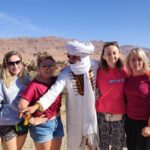
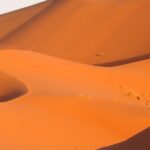
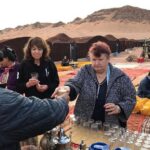
Day 1: High Atlas via Tizi-n-Tichka, then Telouet Kasbah to Ait Benhaddou

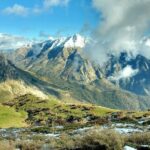
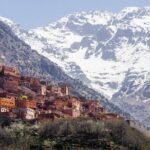
You start at 8:00am from your riad or hotel in Marrakech, and the trip kicks off with altitude. The route goes over the High Atlas using the Tizi-n-Tichka pass (2260m/7500ft), which is described as the highest pass-road in Africa. Even if you’ve seen mountains before, this kind of climb changes the feeling of the day fast.
You’ll get panoramic views over Berber villages as you drive, plus breaks for pictures. That matters more than it sounds. On long desert routes, your eyes get tired if you’re never allowed to stop, breathe, and reset your sense of direction.
After the pass, the itinerary moves into valleys and heritage stops. You drive through the Ounila Valley, then stop to visit the Kasbah of Telouet. A kasbah stop is usually more about scale and atmosphere than “quick photos and done,” and this one fits that idea.
Then you roll onward to Ait Benhaddou. Lunch is included here, and you also get a visit to the mud-brick Castel listed as UNESCO world heritage. Ait Benhaddou is famous for a reason: the walls look like they belong to the riverbed, even though they’re built by human hands. It’s the kind of place where taking an extra 20 minutes can improve your understanding, because the buildings are designed to hold heat, shade, and daily life in a desert climate.
A practical note: Day 1 is where you’ll feel the most “road time.” If you’re sensitive to car rides, plan to sit where you feel least motion (front seats often feel smoother). Bring water and something light for snacks, even though lunches are covered later.
Ait Benhaddou stop: why this UNESCO town is more than a photo stop

You’re not just passing through. The itinerary places Ait Benhaddou as lunch plus a visit, which gives it the time it needs to land.
The key value for you is perspective. Marrakech to Merzouga is often marketed as desert vs desert-only, but Ait Benhaddou is the in-between world where caravans, clay architecture, and mountain valleys all connect. Seeing it while you’re traveling makes the desert feel less random and more like the next chapter of the same geography.
This is also a good moment to get bearings. After hours of driving, your brain wants landmarks. A UNESCO stop like this acts as a “pause point” that helps the rest of the trip make more sense when you’re back on the road.
If you want the most out of it, dress for shade and sun. Mud-brick walls can be beautiful in softer light, but midday can be harsh. You’ll do fine as long as you pack sunscreen and plan to slow down rather than rush.
Day 2 morning: Dades Valley viewpoints, Todra Gorge walking time, then toward the dunes

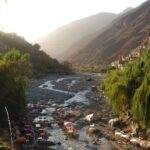
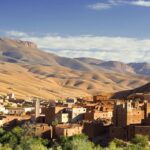
After breakfast, the second day starts with more views. You drive to the top of Dades Valley for an overlooking moment, then head toward the Todra Valley via Tinghir.
Tinghir is described as a contrasted valley with rocky canyons and huge palm trees. That “contrast” is what you’re looking for on this route. It’s not one single type of scenery; it’s shifting environments that make the desert feel earned.
You’ll have picture stops along the way, which is useful because this is the part of the day where the scenery changes often. If your schedule is tight, these stops can feel like constant interruptions. Here, they’re timed so you get variety without losing your ability to enjoy what you’re seeing.
Then comes the main canyon moment: Todra Gorge. The itinerary says it’s 400m/1312ft, and you can walk through it. Walking is the difference between “seeing” and “feeling.” In a canyon, the scale hits you physically. Shade pools along the walls, the air can cool down, and your sense of how people once moved through these narrow paths becomes clearer.
For lunch, you stop nearby Tinjedad. After that, the trip begins its shift from mountain valleys toward Erg Chebbi.
Jorf, Erfoud, and the first sand of Erg Chebbi

This is where the day starts turning into “desert mode.” You head toward the sand dunes of Erg Chebbi via the Jorf, described as an ancient irrigation system with 1000… something. Even without every detail, the message is clear: you’re seeing how water management supported life before desert travel made the Sahara look empty.
Then you continue toward Erfoud, where you see the first sand. That transition is a highlight for a lot of people because it’s the moment your brain finally accepts you’ve reached the Merzouga world.
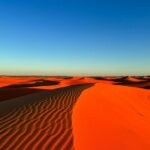
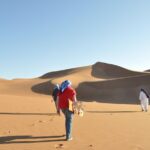
Erg Chebbi is described as having the highest sand dunes in Morocco. When you reach the dunes, the itinerary says you’ll trade the vehicle for camels, with a guide.
This switch is important. You’re not meant to drive right up and “sleep in the dunes” like a roadside camp. The camel portion makes the experience feel slower and more connected to the terrain, even if your time is still guided by the day’s logistics.
The camel trek at Erg Chebbi: what you should expect

Once you switch to camels, you’re doing the signature part of Merzouga: moving through dunes with a guide, not just walking on flat sand.
The itinerary doesn’t give the exact length of the camel trek, but it does indicate a full shift in activity. Expect that your body will feel it after the ride, mostly from sitting and balancing, not from hiking difficulty.
This is also when you’ll want to be realistic about conditions. Erg Chebbi’s dunes can look dramatic but are also soft underfoot. Wear footwear you trust for sand, and keep your phone secured. Wind can pick up without warning.
And yes, this is where you’ll get your best “Sahara photos” because the dunes create depth and scale. The camel walk also helps you avoid the common mistake of wandering in circles, because the guide can position you for the right angles.
Nomad tent night and sunrise on the dunes

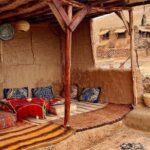
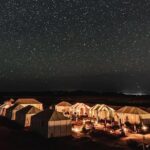
One of the best parts of this tour is that it treats the desert night like part of the experience, not a quick stopover. You’ll spend the night in a traditional desert camp in a nomad tent, with breakfast and dinner included.
You’ll also wake early to assist with sunrise from the top of the dunes, then have breakfast and continue toward Marrakech.
Sunrise is a big deal in the Sahara because the dunes change color as the light moves. Even if you’ve seen sunrise before, dunes bring a different visual rhythm: the shadows stretch across curves, and the sand’s texture becomes more visible. The tour schedule builds around that, which is a smarter plan than trying to coordinate sunrise on your own.
For your comfort, plan for temperature swings. The itinerary doesn’t spell out temperature, but desert nights are often cooler than day. Bring a layer you can actually use at camp.
Day 3: return to Marrakech via Saghrou mountains and Draa Valley oasis

After a desert night and an early start, you’re back on the road to Marrakech. The itinerary notes you’ll take a different way back, which is worth celebrating. It’s easy to get road fatigue when you reverse the same route.
You travel along the mountains of Saghrou, with volcanic rock formations, then you contrast that with the green oasis of Draa Valley. That mix helps your brain switch gears after sand-heavy morning and makes the return feel like a travel day rather than a retreat.
Lunch is again in Ouarzazate, and you finish by driving through the High Atlas with additional picture opportunities. You should be back in Marrakech around 6:30pm.
If you want to make the last day easier, keep your morning gear simple. Once you’re leaving the dunes, you’ll likely want your jacket, water, and sun protection within reach without unpacking everything.
Private guide and private vehicle: the real value of “comfort” here
This tour is private, which shows up in practical ways. You’re not fighting for seats on a crowded bus, and you’re not forced into group timing that can push you through key stops.
The English-speaking driver is also a meaningful inclusion. Even basic conversation can turn a stop like Todra Gorge into a deeper understanding of how the canyon exists as more than scenery.
There’s also the stated ability to customize a private tour to preferences. In a route like this, customization usually means flexible photo stops and pacing, not changing the entire geography. Still, it can help you match the trip to your interests.
One caution: because driving matters so much on this kind of itinerary, the earlier safety note is not something to ignore. If you book, ask directly about the driver and confirm the vehicle is in good shape. A smooth tire is boring right up until it isn’t.
Price and value: is $562.28 per person a fair deal?
At $562.28 per person, you’re paying for more than transportation. The included items listed are the backbone of the value:
- English-speaking driver
- Accommodation in Dades Valley with breakfast and dinner
- Overnight in a nomad tent with breakfast and dinner
- Camels with guide
- Lunches (3)
- Breakfasts (2)
- Dinners (2)
Because lodging, meals, and the camel-and-guide component are covered, your biggest additional cost is basically personal spending (food/drinks outside what’s included) and whatever you choose to buy along the route.
So the math works best if you’d otherwise pay separately for at least two nights of lodging plus a camel trek. If you’re the kind of traveler who hates piecing together desert logistics, the package is likely to feel worth it.
The bigger question is fit, not price. If you want a lighter pace, this may feel like a lot of driving. If you want the classic Merzouga arc—Atlas to dunes to desert night—the included structure is built for you.
Who should book this trip, and who should think twice
This works best if you want:
- A private route with control over photo stops
- A desert experience that includes a camel trek and a camp night
- A route that ties the Sahara to mountain culture through places like Todra Gorge and Ait Benhaddou
Think twice if:
- You get stressed by long days in a car (Day 1 and Day 3 are driving-heavy)
- You’re very sensitive to driving style and want stronger assurances on vehicle safety and driver habits, especially given the caution tied to a driver named Edea
If you’re traveling as a family, the tour data says children must be accompanied by an adult, which is standard—but it also means you’ll want to bring snacks and patience for the long road segments.
Should you book this Marrakech to Merzouga desert trip?
If you want the Sahara in one clean package—Atlas passes, UNESCO Ait Benhaddou, Todra Gorge walk, Erg Chebbi camel trek, and a nomad camp night—this is a solid fit. The included meals and two different sleeping experiences (Dades Valley and the desert camp) help you avoid the usual scramble of figuring it out yourself.
Before you book, do one smart thing: ask who will drive and confirm the vehicle is in good working order. Because desert travel depends on trust, you’re not being picky—you’re being prepared.
If they can give you comfort on that point, then yes: this trip is one of the more direct ways to turn Marrakech into a genuine desert story, not just a day trip.
FAQ
What time does the trip start in Marrakech?
The tour starts at 8:00am from your accommodation in Marrakech.
How long is the Marrakech to Merzouga desert trip?
It’s listed as approximately 3 days.
Is pickup from my riad or hotel included?
Pickup is offered.
Where do we sleep during the 3 days?
You stay in accommodation in Dades Valley (with breakfast and dinner), and you also spend one night in a nomad tent at a traditional desert camp (with breakfast and dinner).
Are camel rides included?
Yes. Camels are included with a guide.
Is free cancellation available?
Yes. You can cancel for a full refund up to 24 hours before the experience’s start time.