REVIEW · HASSILABIED
2 night camel trekking in merzouga desert
Book on Viator →Operated by https://m.facebook.com/saharacameltours · Bookable on Viator
One step from the dunes. That is what makes this 2-night Merzouga camel trek special: you trade phones and roads for Erg Chebbi sand, big-sky nights, and the kind of silence you can actually hear. I like that the pace is built around the best light of the day, with sunset and sunrise front and center. You also get a guide setup that’s more human than rushed, often with Hassan (Hassan Bazzine) and his team running a smooth, friendly rhythm.
My other favorite part is the mix of comfort and authenticity. You’re not just riding; you’re eating well (think tajine and Berber dishes), enjoying Berber music around the fire, and having camp time that feels like it’s yours. One thing to consider: it is a desert trek, so you should expect a bit of basic, sandy life and bring the right mindset for sleeping outdoors under desert temperatures.
Key points I’d pack around
- Deep-dunes camp on night one, so you’re not just visiting the Sahara, you’re in it
- Sunset + star time followed by Berber music around the fire
- Two camp options on day two, including the chance for a more “luxury camp” private-tent setup
- Oasis lunch stop on the second day, which breaks up the long stretch of sand
- A guide team led by Hassan is repeatedly praised for communication and hospitality
In This Review
- Two Nights in Erg Chebbi Dunes: What You’re Really Buying
- Hassilabied Arrival and the Camel Handoff (Where the Trip Starts)
- Sunset at the Deep-Dunes Camp, Plus Berber Music by Firelight
- Day Two: Sunrise, Breakfast, Oasis Lunch, and Your Camp Choice
- The Final Camel Ride Back to Hassilabied (And the Shower Moment)
- Price and Logistics: Is $93.06 Worth It for Two Nights?
- What the Guide Team Really Gets Right (Hassan, Communication, and Punctuality)
- Meals, Camp Comfort, and the Little Details That Matter
- Who This Merzouga Camel Trek Suits Best
- Should You Book It? My Decision Checklist
- FAQ
- How long is the camel trekking experience?
- Where does the tour start and end?
- Is pickup offered?
- Is this tour private?
- Are the camels the main way you travel during the desert portion?
- Do you get to watch sunset and sunrise?
- Is Berber music included?
- What meals are included?
- Do you sleep in the middle of the desert?
- Is a mobile ticket used?
- Is the booking refundable?
Two Nights in Erg Chebbi Dunes: What You’re Really Buying
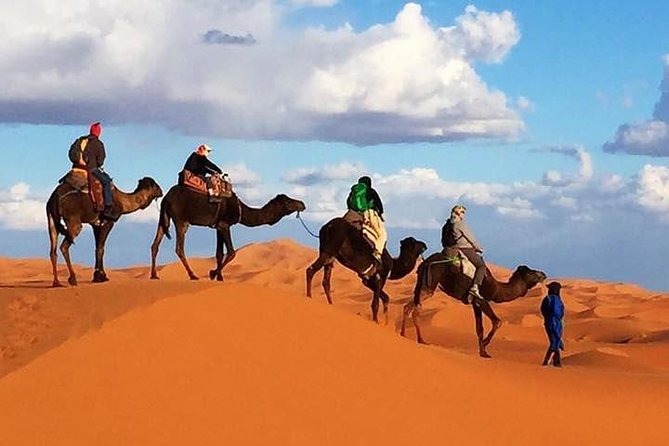
This is a classic Merzouga experience, but the details matter because the Sahara can feel either magical or chaotic depending on how it’s run. Here, the plan is built around the moments that make Erg Chebbi famous: the dune colors changing from afternoon to night, the dramatic quiet after dinner, and that calm you get when the day wakes up again.
You’re paying for more than a camel ride. You’re paying for a full arc:
- moving into the desert at the right time of day,
- eating and relaxing in camp without stressing logistics,
- then waking up for sunrise and finishing the trek back to Hassilabied.
The price is listed at $93.06 per person, which is usually a fair match for a 2-night setup with transport to the meeting area, camel riding, camp time, and meals included in the flow. If you’ve ever watched people spend more for much less time out in the dunes, you’ll understand why this kind of schedule is good value.
Hassilabied Arrival and the Camel Handoff (Where the Trip Starts)
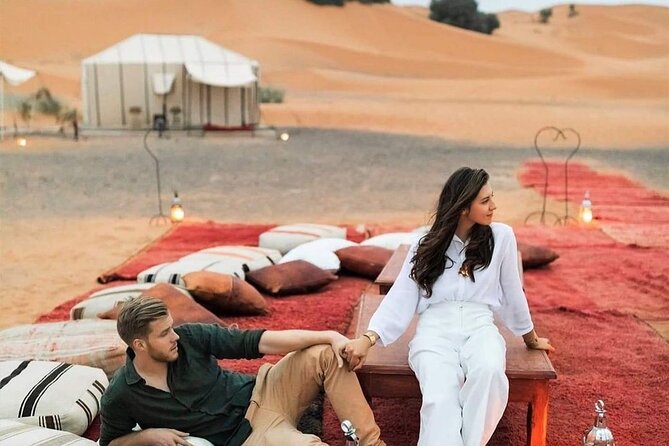
The trip starts at the Sahara Camel Tours Company meeting point in Hassilabied. You’ll arrive, park your car, and grab the bag and essentials you’ll need for the desert portion. This is a small detail, but it matters. You don’t want to haul extra stuff through the dunes or show up with nothing and scramble.
Once you’ve handled your personal items, the camel portion kicks in with about an hour and a half ride to the deep desert camp. That timing is also the “why” behind the sunset experience. You’re not spending hours riding in daylight with no payoff. You’re moving, and then the dunes start doing their thing.
Also, the experience is listed as private (only your group), but near public transportation. So if you’re traveling independently around Morocco, you can still make this work without the day turning into a transportation headache.
Sunset at the Deep-Dunes Camp, Plus Berber Music by Firelight
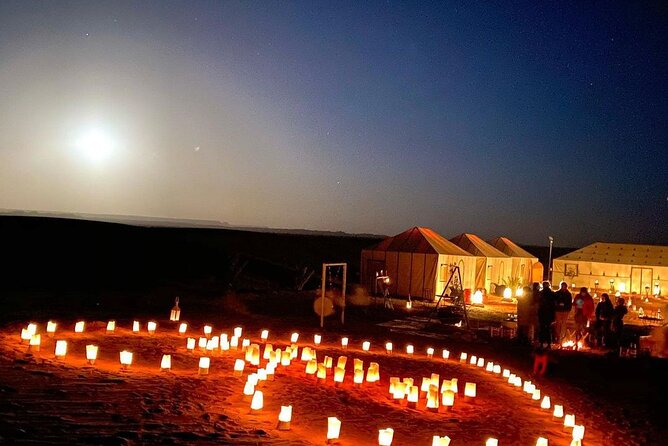
Night one is the heart of this trek for most people. You ride out into the sand, reach the deep desert camp in the middle of the dunes, and then you get the sunset. There’s something special about watching the sky shift while you’re truly out there, not still thinking about cars, roads, and cities.
Dinner follows at camp. Based on the experience descriptions, you’ll get proper Berber meals rather than snack-for-tourists energy. After dinner, the camp hosts Berber music around the fire. This is one of those moments where the setting does half the work. The dunes make the sound travel differently, and you’ll feel how the night slows down.
If you care about authenticity, this is one of the better parts of the whole schedule. You’re not just photographing; you’re participating in a camp evening that feels culturally rooted.
Day Two: Sunrise, Breakfast, Oasis Lunch, and Your Camp Choice
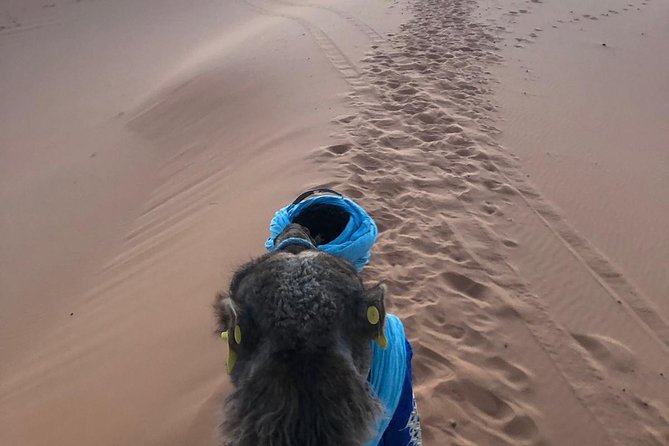
Day two starts early, the way it should. You wake up to watch sunrise, then you have breakfast at camp. That early rhythm is exactly what makes a desert trek work. Sleeping under stars is great, but sunrise is where the day’s mood locks in.
Then you continue on to another spot—described as small oasis areas—where you have lunch. This is a good break in the middle of the day’s movement. It’s also a reminder that the Sahara isn’t only “sand everywhere,” and your itinerary gives you a taste of where people find water and shade.
After lunch, you get two options for where you spend the second night:
- Option one: a luxury camp with rooms in a private tent setup, but it is not in the middle of the desert.
- Option two: return to the first camp for your second night, staying closer to that deep-dunes feeling.
This choice is more important than it sounds. If you want the most dramatic sense of remoteness, you’ll probably choose to go back to the initial camp. If you want more structured comfort and privacy, the luxury camp option may feel worth it. Either way, you still get dinner, and you still get the desert night atmosphere—just with a different degree of “where exactly am I” versus “how comfortable is the setup.”
The Final Camel Ride Back to Hassilabied (And the Shower Moment)
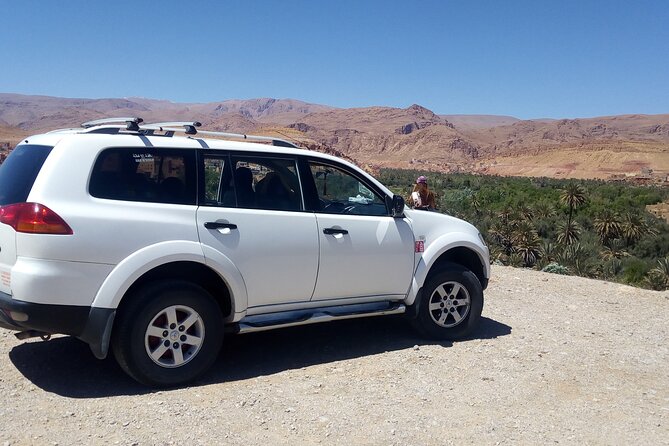
The third day finishes the trek the right way: you wake up, watch sunrise again, and then ride your camels back to your guest house area for breakfast and a shower. The shower detail is not small. After sand, dust, and desert air, you’ll appreciate getting clean before you head on with the rest of your trip.
This is also where the practical value of a good guide shows up. A safe, steady camel return matters, especially if you’re not used to riding. Your schedule ends back at the meeting point area, so you’re not left improvising transport.
Price and Logistics: Is $93.06 Worth It for Two Nights?
Let’s talk value in real terms. At $93.06 per person, you’re getting a package that includes:
- camel riding into the dunes (not just a short loop),
- two nights in the desert camp environment,
- meals built into the experience flow (dinner, breakfast, and lunch stops),
- admission ticket inclusion (so you’re not hunting for extras),
- and a private-group structure.
For many people, the biggest value is time out in the dunes. The Sahara is not the kind of place where half-measures feel special. This itinerary is designed so you spend real time watching the light change across the sand, and you get a camp evening with food and Berber music rather than an ultra-fast photo stop.
The only reason it might not be a perfect match is if you hate basic outdoor sleeping conditions or you need highly modern comfort standards. Nothing in the provided details says the camp is a five-star hotel. But multiple descriptions do emphasize that camps were comfortable and the food was excellent, which is a big deal in a desert setting.
What the Guide Team Really Gets Right (Hassan, Communication, and Punctuality)
One of the clearest patterns in the praise is about the people running the experience—especially Hassan (often mentioned as Hassan Bazzine). The feedback highlights:
- strong communication before the tour,
- a calm, friendly hosting style,
- and punctual, organized execution.
That last point is surprisingly important in Morocco desert experiences. You don’t want to arrive, wait around, and then rush into the night. Here, the timing is structured: you arrive, sort your belongings, ride into the dunes, hit sunset, eat, then enjoy the camp evening. On day two, you’re set up for sunrise and then the second-night choice without confusion.
The guide also plays a role in how safe and smooth the rides feel. People repeatedly note that the guides led them safely and made the experience relaxed—so it doesn’t turn into you worrying about the desert or the camels.
Meals, Camp Comfort, and the Little Details That Matter
A desert trek lives or dies on food and camp vibe. The descriptions point to excellent meals, including dishes like tajine and Berber pizza, and also mention Berber omelette. That’s exactly what you want after a camel ride and an evening with cool desert air.
Camp comfort seems to be handled well too. People describe comfortable stays, private space and tents on at least some versions, and a relaxed pace with time for themselves. That matters because the desert can feel intense. When you get downtime, you actually notice the stars and the silence.
If you’re considering the luxury option on day two, it’s specifically tied to having rooms and private tent setups, just not in the middle of the dunes. That can be a smart compromise if you want more privacy and a more hotel-like feel while still keeping the experience truly desert-based on night one.
Who This Merzouga Camel Trek Suits Best
This tour is a great fit if you want:
- a real two-night desert stay (not a quick day-trip),
- sunrise and sunset viewing that doesn’t feel rushed,
- an experience that balances romance with practical organization,
- and a guide-led setup that feels welcoming.
It also works well for families and mixed-age groups, since the route and pace are described as arranged and safe, and people traveled with kids and still felt it was well handled.
If you’re the type who wants maximum comfort every minute, you might prefer the luxury camp option on day two. If you want the most intense sense of remoteness, going back to the first camp for the second night is likely the better match.
Should You Book It? My Decision Checklist
Book this camel trek if you can say yes to most of these:
- You want Erg Chebbi dunes with proper sunset and sunrise time.
- You like guided experiences that still leave space to sit, watch, and do nothing.
- You’re okay with desert camp life in exchange for big sky nights and silence.
- You care about food and an actual camp evening with music, not just a transport-and-photo stop.
Skip it or switch your camp preference if:
- You need very modern, indoor, hotel-style accommodations for both nights.
- You’re extremely sensitive to sleeping outdoors or to the realities of sand and dust.
Given the strong praise for Hassan and the smooth communication, I’d feel confident booking this if what you want is a well-run, authentic-feeling desert experience with real time in the dunes.
FAQ
How long is the camel trekking experience?
It’s listed as 2 days (approx.) and includes 2 nights in the desert, with sunrise and a return ride on the final day.
Where does the tour start and end?
It starts and ends at the Sahara Camel Tours Company location in Hassilabied, Morocco.
Is pickup offered?
Pickup is listed as offered.
Is this tour private?
Yes. It’s described as a private tour/activity, meaning only your group participates.
Are the camels the main way you travel during the desert portion?
Yes. You ride camels to reach the deep desert camp and then again on the final return toward Hassilabied.
Do you get to watch sunset and sunrise?
Yes. You’ll watch sunset at the deep desert camp on day one and watch sunrise on day two and again on the return day.
Is Berber music included?
Yes. After dinner on night one, there is Berber music around the fire.
What meals are included?
Breakfast is included on the morning(s), and dinner is included at camp. Lunch is described as being served at small oasis places on day two.
Do you sleep in the middle of the desert?
On the first night, you reach a deep desert camp in the middle of the dunes. On day two night, you can choose either returning to that first camp or going to a luxury camp that is not in the middle of the desert.
Is a mobile ticket used?
Yes. A mobile ticket is listed as part of the experience.
Is the booking refundable?
No. The experience is non-refundable and cannot be changed for any reason.